Darren Badenhorst

More than 3000 young chefs submitted their application together with their signature dish to participate to S.Pellegrino Young Chef 2015, the global scouting project to find the world’s best young chefs.

Applications were divided into 20 regions, according to the geographic area of origin, dishes were judged  according to five Golden Rules: ingredients, skills, genius, beauty, message.

A fantastic seven of the Top 10 selected for Africa and Middle East, were South African chefs, and in this series we catch up with each of them.

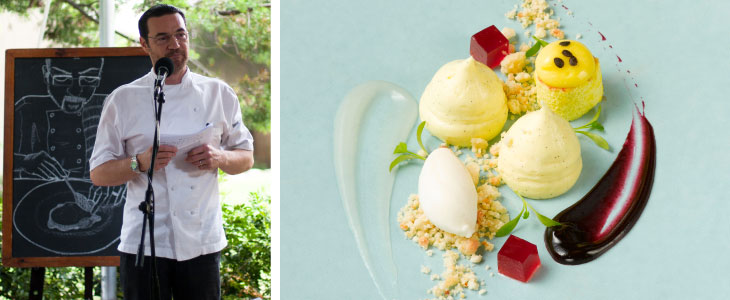
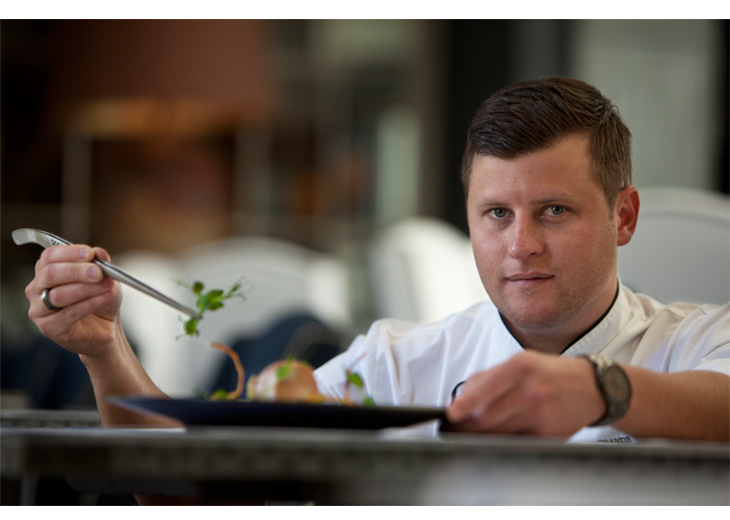
First up is Darren Badenhorst, Executive Chef at Grande Provence Restaurant, Franschhoek.

Darren-Badenhorst-730x520

It is an amazing achievement to have been placed in the Top Ten of this award selection – congrats! Tell us about your journey to entering…

Thank you! I am very excited to be part of such a fantastic initiative. I first came across the entry competition via social media forums, then within a day I had the link forwarded to me from three different people urging me to enter, so I entered and simply hoped for the best.

 Tell us about the dish that got you here…

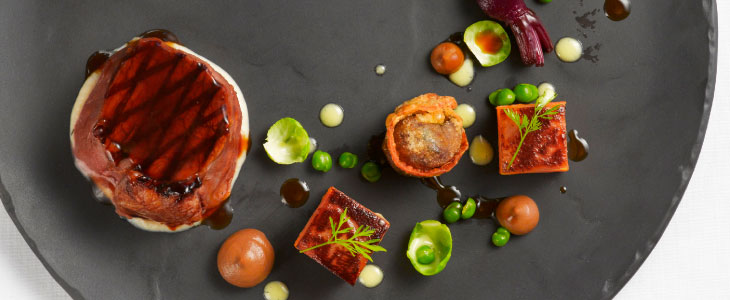
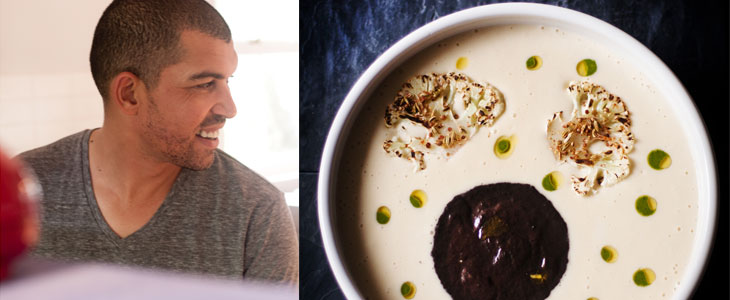
This is a dish off my Autumn menu that I had a serious soft spot for, I find that rabbit is a very underutilized ingredient in South Africa and that is has great potential in a variety of preparation and cooking methods. I experimented with this specific dish over and over to fine tune and tweak the subtle and slightly gamey tones of rabbit with the smoky robust notes of classically cured Parma ham and incorporated both seasonal and imported produce to create a balanced, unique, but approachable dish.

 Without giving too much away, do you have an idea what you will be cooking in the next round?

The next round is the final of the Africa and Middle East region, the 10 finalists will be preparing the dish we entered with – so I am currently working on perfecting the dish I entered.

Chef David Higgs is the selected mentor for this group – daunting or exciting…or both?

I have known David for a while now, we have both been involved in various charity events together and the chef community is very tight knit so I am both excited to showcase what I have to offer to a world class chef and friend, as well as being very happy for him being selected as a judge and mentor- there is no one who deserves it more.

Quickfire Questions…

 Current favourite ingredient… Guanciale (Italian cured meat made from pigs cheek or jowl)

Your foodie guilty pleasure… Tinned caramel (Ed’s note: really!?)

Bucket list foodie destination… Alinea, Chicago Illinois

Drink after a long, hard service… Cucumber and yuzu infused Inverroche Gin on the rocks. I make it at home.

Funniest kitchen experience to date… Wow, way too many to mention one! The kitchen is an entertaining place!

Pet peeve…Unmotivated chefs

Last meal on earth… One of my mothers home cooked originals, shared with family and copious amounts of good wine.

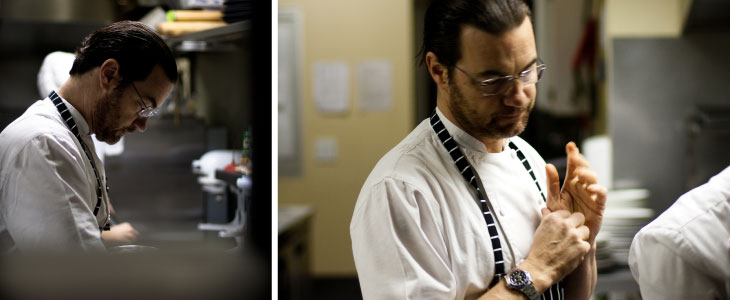
Michael Broughton

Crush sits down to chat with Executive Chef of Terroir Restaurant, Michael Broughton, to find out just what makes him tick…

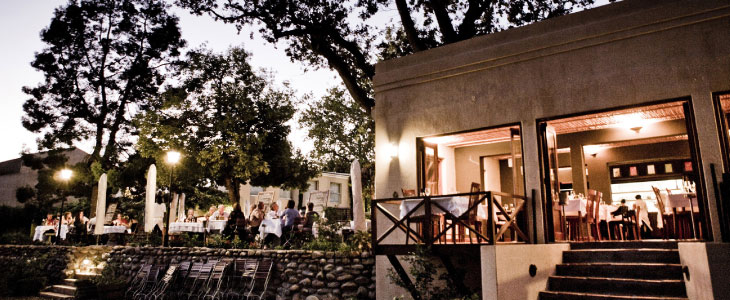
terroir6

You did not train formally as a chef, which is really hard to believe considering your immense success – how did you get where you are today?

You are correct; I did not train formally as a chef. I did 3 years at hotel school (where they teach you management and accounts) and was actually very disinterested in cooking at that time. I spent almost 10 years as a hotelier after my studies and only started my cooking career in 1998. I literally picked up a book called ‘My Gastronomy’ by Nico Ladenis. I then read his second book called ‘Nico’, and decided to start cooking by trial and error, which was actually quite silly as he was a 3 Michelin starred chef! Needless to say it was a difficult and often expensive tuition – when the foie gras in the pan literally ends up an oily mess and you wonder why, or when your quail looks like it has just had open-heart surgery after deboning! I think I have cooked every single recipe in his two books.

You are not from the Cape, how did you land up in the Winelands?

I’m originally from Durban; I left KZN when I was 23 and spent 12 years in Jo’burg. I then came down to Stellenbosch in 2004 as I had met my wife Jane, she is a Capetonian, and so the Cape was a good choice.

terroir1

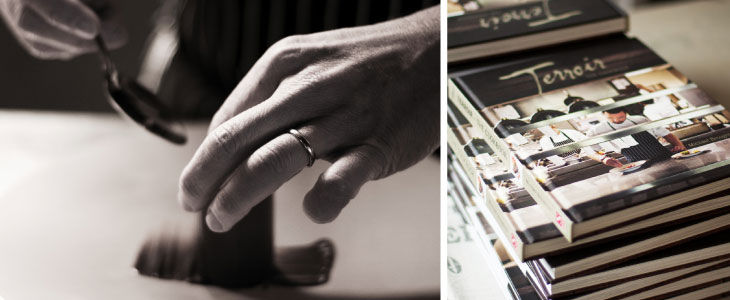
You have recently launched Terroir – the cookbook, how was the experience of putting a book together?

The idea sounds rather romantic, but it was pretty hard work! With a busy kitchen and being dad and husband… it was not easy. Having ideas in your mind is one thing, writing them down in a logical and sequential order was a challenge to say the least.

The food at Terroir is on a scale that would probably be difficult for the home cook to produce, how have you translated this in the book?

As I mentioned in the book it would be great if you have an extra pair of hands to help. However I made a point of highlighting how far in advance one could make each element of each dish, so that on the day it would only be a matter of putting the last minute fresh prep together and then plating. I also gave the conventional cooking methods for the home cook alongside the techniques of sous-vide and other low temperature cooking techniques that sometimes seem challenging to the home cook.

The recipes in the book are also just a blank canvas for creating your own ideas – like a good pair of Diesel jeans you can dress them up or down.

terroir2

How much of a part did your team in the kitchen play in you creating the book?

I think most chefs would tell you that you are as good as your team and they are as good as you have trained them. My two sous chefs, Ruan and Alice, were crucial in assisting me with the hours of mis en place for photography, etc. If it weren’t for their solid commitment, I doubt I would have made it to the finish line on time. They played a huge role in this.

You lead an award-winning restaurant, have had your own show on TV and now a cookbook… what’s next?

If I were 5 years younger I would have more children! But for now, I will let the dust settle a bit – it has been a demanding year writing the book and we’ll see where it goes from here.

terroir3

As a chef it must be tough to eat out without being critical – do you have a favourite spot that you go to?

Chefs often find it difficult to switch off and not be critical – however, as I have gotten older I find it easier to just enjoy what’s been put in front of me with no unrealistic expectations. My family and I enjoy the pizza at Buratta, as well as The Millhouse Kitchen at Lourensford (the kids can run around outside until they have an appetite).

Summer is well on its way; do you have a summer dish that is a crowd pleaser?

We have a new summer starter – confit tomato and buratta with a rosemary-raisin vinaigrette and coconut. Customers are enjoying it very much now with the arrival of warmer weather.

terroir4

If you won the lottery today, would you carry on cooking or would you retire and kick back?

Have often thought of that (haha!) the jury is still out on that one …

Your foodie idol is coming to eat at your restaurant, what South African produce would you want to showcase and what would you make?

I would poach a West Coast crayfish, serve it with rosemary butter, tomato smoor, curry oil and truffle froth nestled on my hand-rolled, bow-tied saffron pasta (farfalle), along with a glass of fine Chenin.

terroir5

Eric Lanlard

What is it about chocolate, and using it as an ingredient, that you love the most?

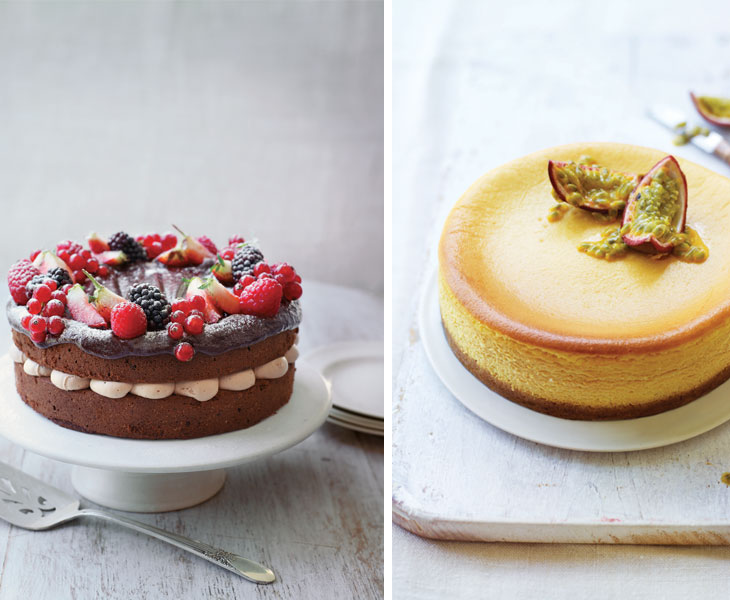
I love its versatility. It can be used for so many recipes and in so many different ways – it adds luxury and a bit of glamour to any dessert or cake. From the ubiquitous cupcake, a marble cake, a genoise sponge to an indulgent chocolate soufflé.

Your desserts are so exquisite to look at. Would you say that what you do is a form of art? What inspires you creatively when creating your desserts?

I am a creative person so, yes, so much of what we do in the kitchen, particularly for the private and corporate commission, is art. I take inspiration from many things. I love art and collect it – I like to travel so that can be influential, too. But for me no matter how beautiful a dessert or a cake looks, it has to taste as good.

 You were a chef in the French Navy. What type of desserts did you conjure up then and was it difficult to get certain ingredients?

I was a chef on the top navy ship in France – the Jeanne D’Arc – so we had an incredible entertainment budget. We cooked for kings, queens and presidents as well as high-ranking diplomats. The chefs were the first people to get off the ship. We would go to the market and buy the freshest ingredients. It was an amazing experience and often I would have to adapt and be creative – ingredients were not the problem, it was the space and the heat in the kitchen. A bit problematic when it came to making chocolate Easter Eggs from scratch!

It has been said that you don’t have a sweet tooth – what is your favourite dessert?

My favourite dessert is one that I make at home and features in my Home Bake book – a pear tarte tatin. It’s simple and easy to prepare and delicious. I have a rule that when entertaining at home, I never bring desserts back from my professional kitchen.

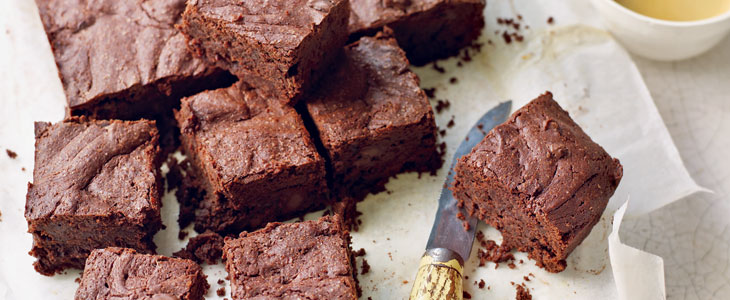
Chocolat---Brownies_Eric Lanlard

Do you have any tips for working and creating with chocolate?

Know your chocolate – try to use a good quality chocolate with a maximum of 70% cocoa solids. I think anything higher than this can be too bitter. Avoid storing chocolate in the fridge but store in a cool, dark place away from spices and any foods with strong odours.

Can you remember the first dessert you ever made?

It was chocolate éclairs aged around six – it was an absolute disaster! I was far too ambitious. I knew that I wanted to be pastry chef from that age and was always experimenting at home. The breakthrough came when I realised that the key to successful baking is to follow the recipe and not to cut corners. That’s my number one tip – baking is a science, so it’s all about ensuring you have best quality ingredients, the correct quantities and that the oven is set at the right temperature.

 You will be travelling to space in 2014. What first ever patisserie masterpiece will you be
making in space?

I will not be baking in space that’s for sure! The whole trip lasts two and half hours and we go just above the earth’s atmosphere – so thankfully I will be sitting tight and praying for a safe landing!

Do you draw inspiration from any other form of art when decorating your desserts?

From everything around me really – flowers, jewellery, fashion, film and travel.

Chocolat | Eric Lanlard

Monya Eastman

Monya Eastman describes her previous self as ‘a corporate girl, stuck in an office, daydreaming about making beautiful things’, that was of course, before she made the bold call to bust free of corporate and get her hands dirty in her own design business.

Monya discovered a gap in the market when renovating her own home – finding it incredibly difficult to source pieces of furniture which fitted her style and necessities, she opted instead to design them herself, and thus Stokperd was born. Stokperd is the Afrikaans word for hobby (or stick horse if you translate directly) and it fits the idea of the business perfectly. Monya has done what so many wish they could do, by turning a passion project into a viable business.

All Stokperd items can be customised to client specs and wood preference. If you prefer something completely unique, or you have an odd space that needs an individual creation to make it work, Monya can visit you, measure the space, take your idea and work it into something beautiful and functional.

Stokperd_730x300(5)

Are you doing anything remotely close to what you thought you would be doing when you were a
little girl?

My very first career choice came to me when I was watching the 80’s movie Flashdance, I was completely obsessed and decided I wanted to be a dancer, so no – it’s not even remotely close!

You’ve done what many people dream of doing, leaving the corporate world and pursuing your dream career, a very daunting adventure indeed; has it been as rewarding as you imagined?

It feels good to start something and to see it grow and evolve into something bigger. I never felt that my previous jobs defined me, and now I can say that my work is an extension of who I am, and that is the most rewarding part. But I must add that it’s not always as romantic as it seems – there’s anxiety and stress involved a lot of the time.

Stokperd_730x300(2)

What is the most unexpected thing you have learnt through the experience of going it on your own?

I crave routine! When I left the corporate world I thought that I would never keep regular hours, and in the beginning I enjoyed being “organic” with my time, but now I work in a shared office space and keep a strict schedule, which works very well for me.

Have you ever created something for a client and then wished you could keep it for yourself?

Yes it happens, but it was particularly hard to part with the Nin desk – I am in love with it and plan to get one for myself as soon as we move into our new house.

Stokperd_730x300(3)

All your products are named with funky, fun names and accompanying stories like ‘The Moop Table’, how do these come about?

When I started out, one of my first commissions was for the JR Ewing table, which was a real bad-ass as it took some time to get it right, so I thought this table needs a name and a story that is going to describe what I went through when we were making it. So now it’s become a thing – sometimes clients name the pieces too, like the Peggy cabinet, which was named after the buttoned-up copywriter in the Mad Men series, and if you know her character you will completely see the similarities.

Your pieces are often more than just functional, they are pieces of art, what inspires your designs?

I feel strongly about furniture that enhances your life and is not just good looking for good looking’s sake. So I guess I will always look at the function of the piece for primary inspiration, and then figure out a way to make it look beautiful.

Stokperd_730x300(4)

Frederic Faucheaux

We gather you are a classically French trained chef, who has lived in SA and now works in Singapore, how did this transpire? Tell us a bit about your background

I did all my trainee years in France; learnt the fundamental basics of culinary cooking and French cuisine.

I moved to the UK when a recruitment agent offered me a job in Manchester, during that time I learnt valuable life lessons and I also learnt the language of ‘Shakespeare’. I had arrived in the UK not knowing a word of English, but I was hungry for knowledge and grabbed every opportunity I could, and I started to move up on the culinary ladder.

While in London I met my future wife who was from South Africa and we decided to move in the direction of Africa. I moved firstly to Zambia with Sun International, here I learnt how to cook with limited local resources and to improvise while still maintaining a world-class standard. From there we moved to Cape Town and it was here that I was appointed Head Chef at Tank Restaurant in the Cape Quarter, and then went on to open Geisha Wok and Noodle Bar in Mouille Point. I got to know the city and the suppliers, and this proved valuable when the One & Only called to offer me a position at Nobu restaurant. I stepped down as Head Chef and at first took on the position as Executive Sous Chef, as it was a foot in the door. I could not refuse to work for one of my long time culinary hero’s – Nobuyuki Matsuhisa. It was only after almost two years, that I took on the role as Executive Chef of Nobu Cape Town.

Pan-Asian is quite a departure from the French style of cooking, has it always interested you?

My love of Asian food started when I was in London, at the time there were Sushi bars were opening on every corner and I think the bug start here. My main interest though is Japanese food – it is so fresh and simple, but also complex. The main ingredient must speak for itself, and not be covered up with many ingredients. I believe Japanese cuisine is one of the best in the world; there are more 3-star awarded Michelin restaurants in Tokyo, than any other city in the world.

Frederic_730x300(1)

What is it about Pan-Asian food that you find intriguing, what made you pursue this style?

The final beauty of each dish and the fact that the combination of every ingredient you use can change the entire taste. It is also vital that you use only the freshest produce, the dishes are simple and the ingredients must speak for themselves. The goal is to enhance what nature has already provided for us.

Does your classical French training influence your style now?

I would not say influence, but more likely elevates it. Just as an artist will use all his colours on his palette, I try to find a balance of all my experience, to provide the harmony that Asian cuisine has.

Frederic_730x300(2)

This issue we are talking art – do you believe that food is art on a plate?

100%! Most customers and critics will rate you on the food presentation first. You eat with your eyes, that’s why simplicity is very important – don’t cover your food. Play simple, don’t overcomplicate.

The style of food you serve is plated beautifully, what inspires you and these designs?

I am in love with fresh food markets, using the freshest and best quality produce as far as possible. After that it’s just about experimenting and keeping up with world trends, putting your personal signature to it and still keeping it simple.

If you could choose anyone, alive or dead, to cook a meal for now, who would it be?

It would be my parents. They were very shocked when I told them I was leaving for the UK to work; they could not understand why I should need to work abroad. I can still see my mum’s face the day I told her I was leaving. Now I feel I can show them why I move around the world, and how I have grown. The last time they ate my food (other than home-cooked meals in my mothers kitchen on holiday) was almost 20 years ago, when I was training at a local restaurant in our neighbouring village.

Frederic_730x300(3)

What would you cook for them?

I would spoil them with a wonderful product they love and know – pan-fried foie gras and sautéed scallops, but also introduce some of my favourites – roasted black cod and grilled Wagyu with a Japanese-French twist.

If someone could have given you a valuable piece of advice about your career when you started out, what would it have been?

Put 100% commitment into what you do. But also, in our business there is a lot of arrogance – a restaurant cannot run with one man alone. Often there is no harmony between front of house and back of house; one thinks their role is more important than the other. Always remember that one cannot function without the other, no man is an island.

Do you plan to return to SA and will we see you cooking in Cape Town again?

Yes absolutely, one day I will be back, but not at the present time – I still need to explore and see the world, my main focus at the moment is Asia and Asian cuisine.

Frederic_730x300(4)

Marijke & Tracey-Leigh

Who are the faces behind Four&Twenty?

Myself, Marijke Duminy, and my partner in crime, Tracy-Leigh Genricks, are the chefs and co-owners of Four&Twenty.

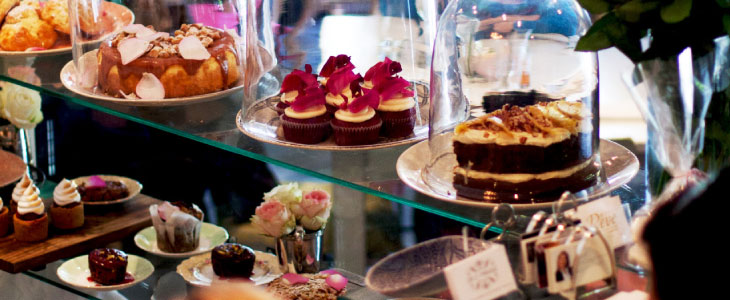
At the café Tracy is in charge of the pastries and bakery items, which fill our jewel-like box of delights at our pastry counter as you enter the shop.

I am the head chef of the café section; the menu is seasonal and changes as often as my inspirations shift and as I explore new flavours.

Another face which has become a part and parcel of the Four&Twenty experience, is Tracy’s mother Linda Genricks, who spends the majority of the week manning the patisserie counter; she has become a large part of why many of our regulars come back again and again – she warmly welcomes each person as if they were an old friend and is always more than willing to describe any of the quirky menu, or unconventionally delicious, pastry items. Not only has she fast become a mother to all at the café, but she is now also a confidant and dear friend to most in our unique Chelsea Village community.
4&20_730x300(3)

How do you two know each other?

We are both chefs – Grande Diploma Cordon Bleu graduates of Silwood School of Cookery. Tracy was the practical cookery teacher at Silwood Kitchen and I was her student. We always enjoyed each other’s company at school, but never managed to expand on that initial ‘click’ until a year later, when we ended up travelling to Europe together.

What do you think initially inspired your love of food and your desire to turn it into a career?

Food has always been a big part of both of our lives – it is part of what makes sharing food with others so rewarding for us. Food is an enormous part of everyone’s frame of reference and is thus an opportunity to extend a common thread to people from different walks of life, creating a shared human experience.

Tracy and I have both been privileged enough to travel abroad throughout our lives, giving us the opportunity to experience this common thread through the lens of many different cultural precepts. From old family recipes served around the long, noisy tables of adolescence, to trying totally foreign combinations and ingredients on our individual quests for flavour discovery abroad, we have both developed a deep sense of appreciation for the eternal balance between that which is familiar and comforting, and that which is thrilling and requires an open-minded sense of adventure! All in all, a pretty fascinating journey indeed!
4&20_730x300

So whose idea was it to go to France?

Tracy once flippantly mentioned in passing that she was looking for a travel buddy to see France with and I jumped in without a second thought. In no time at all, we had planned a culinary road-trip to die for, from Paris to Mont Saint-Michel, Bordeaux, Lyon and even a few rural gems off the tourist-beaten track, like the hidden magical foodie heaven of Sarlat along the river Dordogne! Little did we know, that the trip we planned as an opportunity to literally eat our way around France, would be the turning point in both of our lives to finally find our soul’s expression in something real and honest and truly ‘us’!
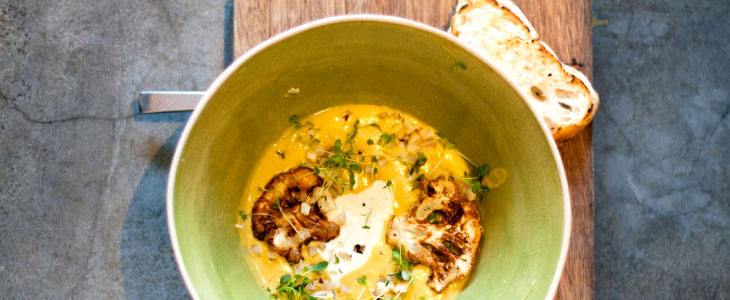
4&20_730x300(4)

France is definitely a place one would find plenty of inspiration as a chef, was this the case for you both?

Without boring you with every detail of every bite along the way (which we carefully documented and drew diagrams of at every café, bakery, restaurant, food fair and market), we made our eagerly anticipated pilgrimage to Ladurèe in Paris. This was a particularly exciting stop for us, not only because of Tracy’s incredible natural magnetism towards fine patisserie, but also because we knew the flavours would be totally mind blowing, and they certainly did not disappoint!

Triumphantly, with the perfectly wrapped and whimsically ordained parcel-in-hand, we skipped along the Champs Elysee hand-in-hand, singing in broken French (we have pictures to prove it and it was rather a spectacle as you may imagine). We could not contain our excitement at opening our box of mystical treats at the foot of the iconic Eiffel Tower we had travelled so far to see! Once we had unceremoniously thrown ourselves down on the cobbled square, with the paternal tower immense and imposing above us, we carefully peeled each layer of luxurious tissue paper away to find what can only be described as one of the most profound culinary experiences of either of our lives. While biting each perfect macaron in half to share every morsel of this ingeniously flavoured, authentic, triumph of technique (with tears in our eyes and copious amounts of gasping and ‘oh my word-ing’), we squeezed each others’ hands and without so much as a look or another word we both declared that we would take this feeling home with us, together.

Many think that we came home from Paris to open a Parisian café, but in fact we came home to open something that makes us feel the way we did that day, when the sheer wonder of all the possibilities for joy in food totally overwhelmed us and changed us forever.
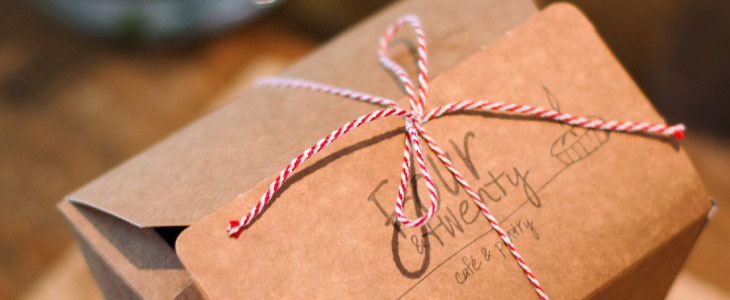
4&20_730x300(5)

Do you have a memorable food moment from your trip to Paris or perhaps of somewhere else in your life that cemented the desire to make this a career?

After our powerful ‘aha’-moment under the Eiffel tower, every crumb that we inhaled with utter fascination and glee on our month-long culinary pilgrimage, became yet another inspiring affirmation for our new-found purpose.

Some of the highlights were eating paper-thin crepes stuffed with warm and oozy chestnut crème on the steps to the Notre Dame Cathedral; buying the most insanely beautiful little porcini and truffle-filled pasta parcels at the local Parisian food market and cooking them amongst squeals of anticipatory elation in our kettle in our tiny room; real hand-whipped-in-copper-bowl omelettes on the tortuous and spiralling island of Mont Saint-Michelle; perfect Sole Meunière at a sidewalk café in Bordeaux accompanied by copious quantities of an untraditionally paired bottle of velvety Merlot (do not despair however, our wine-paring skills have definitely been significantly refined since…); the ultimate in simply prepared but mouth-explodingly good steaks, at a quirky bistro in Lyon and piles upon piles of duck-fat confit potatoes scoffed greedily in our medieval hotel-room in Sarlat! Just to mention a few…

Where does the name of the Café come from – we’re assuming the nursery rhyme?

“Sing a song of sixpence, a pocket full of rye
four and twenty blackbirds baked in a pie…”

It is from the Mother Goose nursery rhyme indeed – one of both our favourites (probably because even as babies we were drawn to the nursery rhymes with food in them), but also because it conveys a whimsical sentiment, possibly of a foregone time where life was lived more slowly and with more appreciation for subtler joys.

We thought it was an open-ended enough name to also not be something which is predefined and limiting to us – it is supposed to highlight a feeling rather than anything specific, which can be developed and played with as our own food journey takes shape over the years to come. We didn’t want to constrain ourselves or be boxed into any category – all we hope to be is a celebration of eating, in as many forms as we can explore!
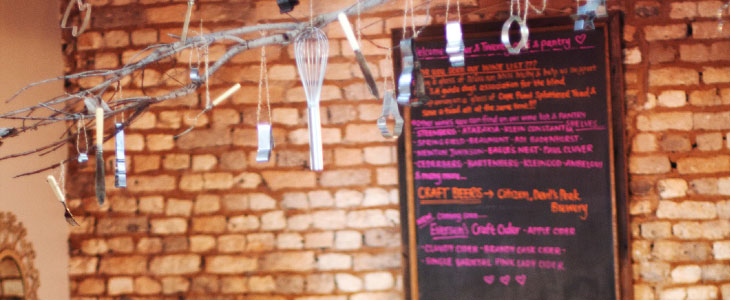
4&20_730x300(2)

Is there a Café signature dish, or something that you are becoming known for?

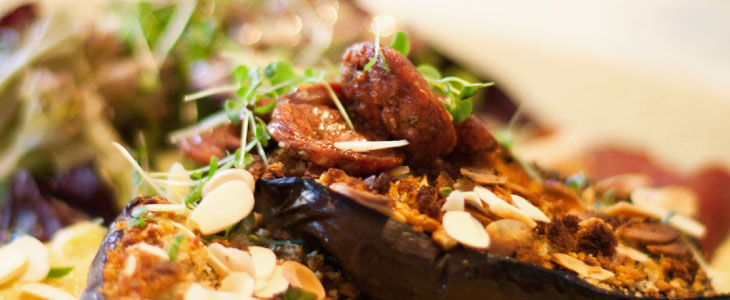
When we created our ‘Eggs Be-Lean’ dish (as a funky twist on classic Eggs Benedict, but aimed at our more calorie-conscious diners), we had no idea that it would become our signature dish, but somehow we managed to catch on to the low-carb revolution that has changed the general eating style of many South Africans in the last few years. The dish is made of a truffle-roasted aubergine and mushroom rosti (no starchy potatoes in sight), which is then crisped in a mini pan and topped with two soft-poached eggs and a lighter yoghurt-hollandaise, garnished with confit tomatoes and finished with either smoked salmon, local bresaola or crispy bacon. It has become so popular that we have to prepare over 10 kg of aubergine and mushrooms daily! Even Doctor Tim Noakes himself orders our Eggs Be-Lean with double crispy bacon for breakfast at least once a week!

You’re about to hop on a rocket ship headed for a new dimension, what Café item do you grab to take with you…you can only take one!

Marijke: Sjoe! This is a tough one! If I had to go and cook in another dimension, I would probably make sure I had a good, sharp chef’s knife with me, since this would probably come in handy too if this other dimension contained any aggressive or sinister native aliens that wanted to eat me… I am pretty good at wielding a knife. Otherwise, if I could be assured that this other dimension is peace loving and has sharp implements readily available, I would definitely first grab my Thermomix- the king of kitchen equipment!

Tracey: I would take the baked vanilla cheesecake with caramel and toasted macadamia nuts – the whole one! What if they don’t have cream cheese in the new dimension?

Westley Müller

Westley_recipe_1

Who is Westley the chef?  Tell us who you are and how you got here.

I was born in JHB, but grew up on my grandparent’s farm, eating everything the land produced. Fruit from the trees, rabbit, venison, proper ‘plaas-hoenders’ and offal for breakfast. My first memories are about food, the smell of a slaughtered animal, seeing the breaking down of the whole carcass and all the uses of the different cuts of meat, including the offal, which was the first to be cooked and made the best breakfast ever.

As a child I was always in and around the kitchen, irritating, as well as helping, my mom and gran. Growing up in a house where art and a love for nature were the norm, I thought it would be an easy decision to study game-ranging and professional photography, but there was always the love of food, and this pushed me to study at the Institute of Culinary Arts.

Being a chef comes with all sorts of responsibilities, like not being wasteful, being environmentally and sustainability conscious, how does this affect the way you cook?

Minimum wastage is one of the basics you’re taught as a chef, but you only get to practice it once you are in the industry. I have always believed in eating and serving the whole beast, so being sustainable has always been my norm. If you cook with respect for your produce, you will never waste.

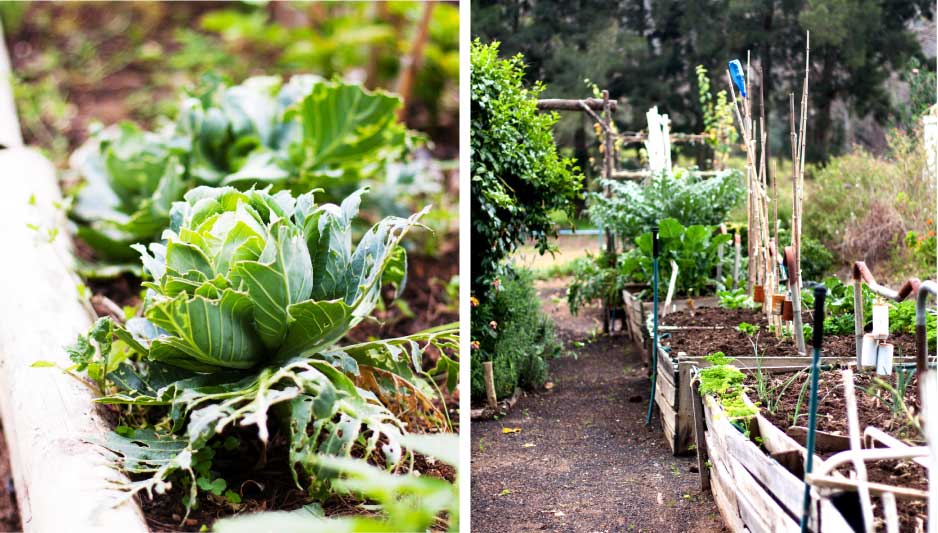
We have a vegetable garden on the farm where we grow all our own organic vegetables and we use all the food scraps from the kitchen for compost.  We don’t waste any energy, what we don’t use goes through a biodegradable composting system. We also use no pesticides, but instead plant specific plants within the vegetable garden, which deter certain pests.

Our beef and pork is also locally sourced; we use grass-fed, pasture-reared beef and pork, and Farmer Angus’s real free-range eggs. All our lamb is certified-Karoo lamb, sourced from a few certain farms in the Karoo. We believe in supporting small suppliers who understand sustainability, and have environmentally healthy farm practices. The bottom-line is that it is part of our food philosophy to cook, and be sustainably and environmentally correct, as far as we can.

Westley_recipe_2

What do you think is the most important responsibility chefs today have when cooking and educating the public about food?

To steer away from consumerism and bulk food. We have to teach people that animals don’t only have fillets and sirloins. There is so much more to an animal, and to respect the beast, you have to eat the whole animal. Restaurants should concentrate more on lesser-known cuts of meat, and teach people that they are as tasty, if not more so, than a piece of fillet. Very important as well, is that we don’t need to eat meat everyday, rather eat less meat, but choose healthier and better quality meat, this is good for your own health as well as for the earth.

Diners are getting more and more used to seeing odd ingredients on the menu, especially when it comes to snout-to-tail cooking. What is the one ingredient you serve/have served that raises the most eyebrows?

Pigs ears, pigs tails and lamb peertjies! I think it is a texture thing, or the idea of sucking and chewing on a pigs tail. The lamb peertjies, well do you eat lamb balls?

Do you have a green thumb? If so, do you look after the kitchen gardens at Towerbosch?

I love a pretty and resourceful garden, but think you need ample time to really work at it. Ingrid, the farm-owner’s wife, made our vegetable garden her hobby and she is pretty good at it. She also does sustainable gardening courses for farm owners and workers.

Westley_recipe_3

Is something that home cooks can do to make their lifestyles more enviro-friendly and sustainable?

As I said before, think before you just buy the first piece of meat you can get, buy better and buy less. Try a tougher cut of meat; that animal died to feed you, so use the whole animal. Start a Bokashi compost system and work all your offcuts of vegetables and meat back into your garden – you are giving back energy and your vegetables and garden will flourish.

Make buying food fun, rather drive out on a Saturday and buy your weeks vegetables at an organic market, and buy meat from the loads of farmers that also sell meat at these markets. These suppliers are prone to use less pesticides and antibiotics on their crops and when rearing their animals, than the big farms selling vegetables and meat by the ton.

If you could choose one unconventional ingredient to grow on a tree, what would it be?

Offal! Every part of offal, so we can teach people to start eating it again. To recognise that offal is healthy, and when cooked in the right way, can compete with any good steak or fillet.

If you could choose to fly right now anywhere in the world and cook for someone, who would it be?

Sweden. To cook with, not for, Magnus Nilsson. – he is a young chef at Faviken Restaurant. Their whole cooking philosophy is to forage for all their ingredients, as well as to use the whole animal – proper nose-to-tail eating. We have the same philosophy about food and respect for the animals we consume.

Westley_recipe_4

What would you cook; the pantry has everything your heart desires?

I would start of with a steak tartare cut from the hanger steak, with proper sourdough toast. Mains would be slow-braised ox heart on celeriac pureé with crispy shallots. For dessert, apple tarte Tatin and home-made tonka bean ice-cream.

What gets you out of bed in the morning and into the kitchen?

Food! I live my passion and my wife shares the same passion, so from getting up till getting home after work, food is on my brain. It helps if you are married to a good chef and both of you share the same passion.

Westley_300x300

Reuben Riffel

Reuben Riffel Many people don’t know that you worked your way up through the kitchen to become a Chef de Cuisine, rather than studying the traditional way; can you tell us a bit about your journey and how you got started in the industry?

I was born and grew up in Franschhoek, many of my family members worked in restaurants or hotels. During school holidays I used to work in some of these establishments for cash, but to be honest I never really enjoyed it. After I finished Matric, I started as a barman and then moved on to assist in the kitchen on busy days. I realised I enjoyed the kitchen more and the chef at the time asked me to stay on as a trainee chef. I felt more at a home in a kitchen; I was surrounded by creative people and delicious food. I discovered my love for cooking and my passion for the cheffing profession.

You’ve been appointed the newest judge on Masterchef South Africa – how did this come about?

I auditioned initially for Season 1, but had to pull out of the race back then due to other commitments. I was approached again at the end of last year and was in a better place to take it on. I enjoy the concept of the show and it’s done in such a professional way, that I could not resist. Reuben_Riffel Does the thought of judging amateurs with big food dreams daunt you, or do you feel you can relate to them?

I can relate to them, but I’m also more of a realist, so I hope I can give constructive feedback. Typically in these reality-style shows there’s the really critical judge, the kind judge, the crazy eccentric etc, where do you think you’ll fit into the panel? I don’t think the show is formatted like that, as far as I know there’s no criteria dictating that, I’m just gonna be me. There are different sides to all of us and I guess throughout the series all three of us will display a little bit of all of the above.

A Chef traditionally spends a lot of time behind the scenes making the magic happen, how do you feel about being front and centre and in front of the camera?

Times are changing and our profession has evolved as well, I respect the hardworking chefs and cooks in kitchens all over. I grew up as a shy person, with non-existent confidence. I think somehow I’ve pushed myself to be in positions where I challenge myself more in that regard. I enjoy the challenge. Truth to be told, I would probably still end up behind the stoves, doing what I do best.

Reuben Riffel

What qualities do you look for in an amateur chef that makes you think – he/she has the ‘it’ factor and has what it takes to make it?

When a cook can make simple things well, like making an omelette or scrambled eggs, the way they sauté and season, and when they take care even when making hot chocolate or a pancake. People who love food and cooking care more about the person that’s going to taste and eat their food, and they try their best to give those people the best experience possible.

What are your top 5 basic kitchen skills that any aspiring chef should work on and hone?

• Knife skills – chopping, slicing, deboning, filleting
• Restraint
• Temperature control
• Understand caramelisation, sautéing, de-glazing, meat resting
• Presentation
What is on your foodie bucket list? i.e. meal/place/personality

I want to explore the Kyoto and Tokyo, food scenes. I want to visit Peru and Mexico, there are interesting things coming out of there regarding chefs and food etc.

You have achieved so much in your career and you’re about to check off the reality TV box, is there something else on your radar that you want to achieve?

I have many more things to achieve, for now I’m working on being a good husband and parent. : – )

Your advice for those who are about to embark on the Masterchef journey to fulfil their foodie dreams:

It’s important to understand the nature of this competition and to re-evaluate yourself and what you would like to get out of being part of this. Know that it’s tough and that you are only as good as the last dish you cooked. Whether your mom or your family loves your food is irrelevant, you must believe in yourself, cook to your strengths, focus on making delicious food and not interesting conceptual creations.

Reuben_Riffel


Tal and Nirit

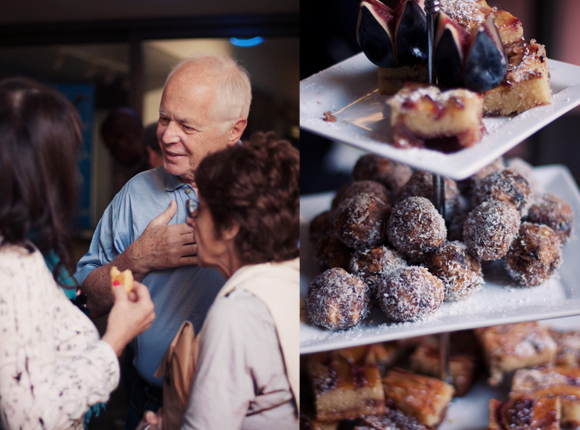
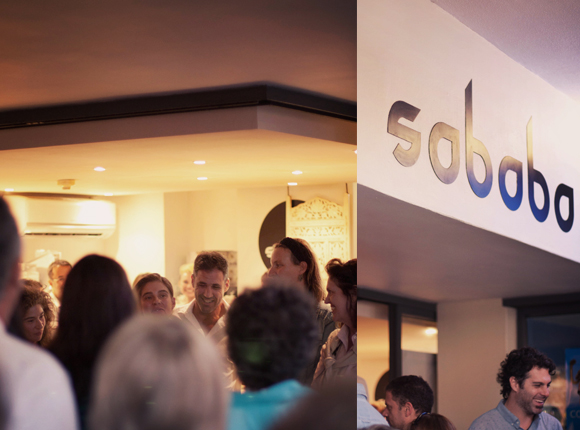
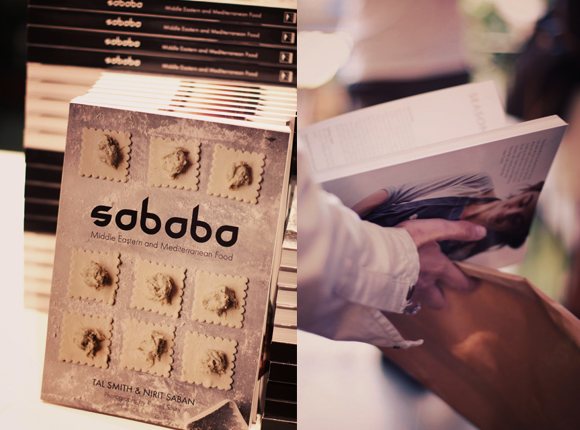
Last night, Crush was lucky enough to attend the launch of Sababa’s beautiful cookbook. Held at their Sea Point branch, the evening buzzed with passionate Sababa fans, laughing, cheering and chomping on the delicious finger foods, which gave us a tantalising taste of what to expect in the cookbook.

sababa-3

sababa-1

Sababa is one of our absolute favourite spots for lunch. Their delicious Mediterranean and Middle Eastern dishes as well as the friendly team are what keep us going back for more and with the launch of their brand new recipe book, we could not be more thrilled to recreate their dishes, one mouthwatering page at a time.

“Sababa is all about uncomplicated and wholesome food with a Middle Eastern and Mediterranean influence. Food is prepared fresh daily in the Sababa kitchens by sisters Tal and Nirit, and a group of dedicated and passionate chefs who love to cook and “live” food. Using local ingredients and fresh produce, Sababa is full of recipes which anybody could cook at home.” (via Jacana Media)

Congrats and well done, Tal and Nirit!

sababa-2

The Sababa cookbook can be purchased at both Sababa stores, most Exclusive Books and Wordsworth stores and online at Jacana Media and Kalahari.com. More outlets to come.

Find them:
Shop 14, Piazza St. John, 395 Main Road, Sea Point, Cape Town ~ Tel (021) 433 0570.
OR 231 Bree St. Cape Town – Tel (021) 424 7480

[new_line]

Rudi Liebenberg

How does one get to become the executive chef at a hotel like the Mount Nelson? It must have been an interesting journey?
Well, they phoned me!

I always knew that I would be a chef or an artist. After leaving school I defied my mother by insisting on becoming a chef. I started off making pizzas (bad ones, at that) and worked my way through various other positions before studying at the WITS Hotel School. A couple of years later I had worked in the kitchens of the best hotels in Johannesburg, including the Hyatt Rosebank and the Saxon Boutique Hotel.

Rudi_Liebenberg_2

Do you come from a family of foodies?

I come from a family of cooks and foodies.

Is there something new food-wise that you are working on currently?

Both the Planet Restaurant and Oasis Bistro have new menus. But food-wise, I have been working on farm-to-plate food, gluten-free offerings for Morning Tea and planning picnics on the lawn amongst the new sculpture exhibition.

We have heard there is strange obsession with the common carrot?

*Laughs* There are carrots and then there are carrots, so to speak. Good quality is rare and the most important thing is to respect that and to present the ingredient as simply and honestly as possible, even if it is only a carrot.

Which new international food trends excite you?

The current trend of using everything and wasting as little of your produce as possible. Also capturing the integrity of the ingredient.

What do you think of modern, experimental cuisine?

I am not a fan of using strange chemistry in my food.

rudi_Liebenberg_food

We often think of a chef as an eccentric artist/scientist – is that a naive view and is the reality that your role is more meticulous accountant than wayward creative artist?

There is always admin to be done, but fortunately I get to be creative every day.

What is your process in developing a new recipe?

I always sketch a new recipe as part of my development process. I also like working with the whole kitchen team to develop a new recipe. I like taking something beautiful and turning it into something amazing.

rudi_liebenberg_ingredients

How does food enrich your life outside of the heat of a commercial kitchen?
I love eating! But being creative also adds generously to my life.

Congratulations on winning the Sunday Times Chef of the Year 2012. How important are awards to you? 
Awards are important for publicity, and I see it as my responsibility to share the experience with my fellow chefs in the kitchen.

rudi_liebenberg_sue_baker

Is a chef being caught in a fast food joint the equivalent of a South African politician being caught with his hands in the till?

No, chefs have to eat too. I like a good pizza or burger just like any other guy; the trick is to know where to find the best one.

Inspiration – is there a type of cuisine that you favour and does this come through in your food?

I quite like cooking with different spices, so I find that Indian and Spanish cuisine interest me. I am also very fond of Indonesian cooking, after spending some time there.

With an all-consuming job like yours do you have time for other interests?

Doing artistic things, like painting and sketching. I also enjoy reading a book and some good music.

Tell us about the chef’s table at the Mount Nelson.

I inherited the concept when I joined the Mount Nelson over three years ago. It is a very special experience to be so close to the action in the kitchen.

You have cooked for some very famous people, we understand. Any particular people who stood out?

Nelson Mandela – he likes simple food and is always very humble, thanking the chef personally. The actress, Lucy Liu – she eats anything you give her. And George W Bush, who had various secret servicemen tasting the food before he ate it.

Can you tell us about the wine-and-dine series that you and sommelier, Carl Habel, are doing?

It is great fun working with Carl. He understands food and brings a lot to the table when planning the wine-and-dine series. This ensures that the pairings are perfect, showing the best of the wine and the food.

Lastly, tell us about the fresh produce for the hotel – the hotel has its own vegetable garden – how much of the demand for fresh produce for the Mount Nelson comes from its own garden?

This was a great project from the start, with produce grown specifically for the hotel. But unfortunately we ran into some difficulty as the garden is climate dependant and entire crops can be wiped out by the wrong weather. The kitchen has therefore changed its strategy and designs the menu around what fresh produce is available, rather than the other way around.

Fanakalo

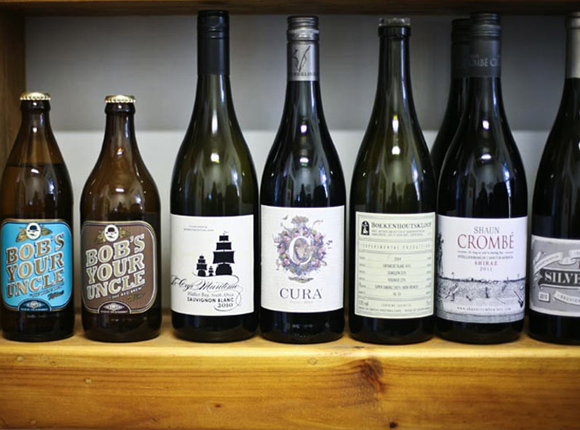
Crush interviews wine label designers, Jan Solms and Rohan Etsebeth of Fanakalo.

When, Where and How?

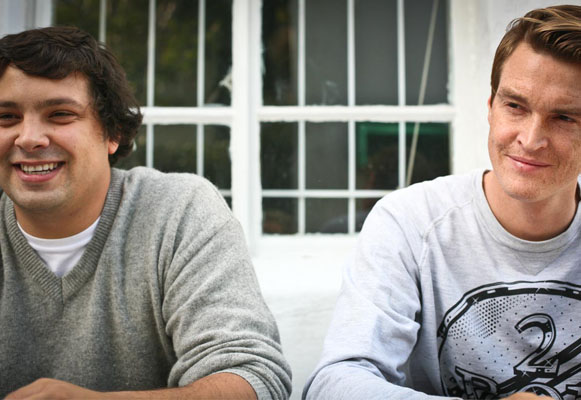
We started Fanakalo in Stellenbosch in June 2009. Both of us studied at Stellenbosch University but we met through mutual friends on a road trip through the Transkei.How did you end up designing wine labels?

We never set out to do wine labels exclusively, but being in Stellenbosch it makes up the bulk of what we do. The guys from Boer & Brit were our first clients and from there the demand has grown by word-of-mouth.

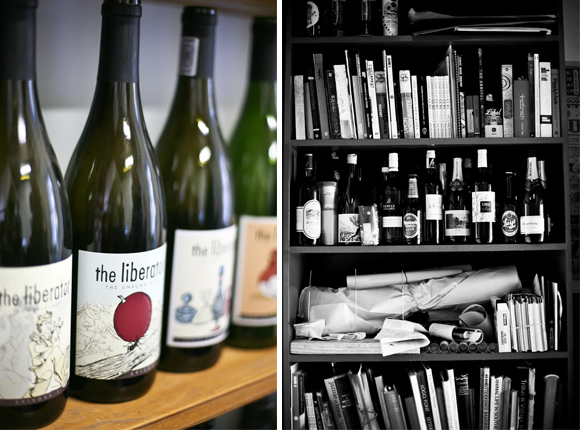
labelsbike

What inspires you to design the labels?

We test-drive the wine first of course! Inspiration ranges from old packaging and design from the 1920’s, interesting signage, etchings, hand typography and retro surfing culture to even just cup of good coffee. Once we’ve been briefed, we go off in search of visual inspiration that will fit the concept.

labels

Is it important that the label reflects the style of the wine, ethos of the cellar and winemaker?

We take the personality of the winemaker/winery into account and see if we can convey it visually. The style of the wine plays a significant role but people who want us to design their labels are rarely looking for the serious ‘stiff-upper-lip-family-crest’ formula.

Your favourite brand to work with in your portfolio?

It is hard to single anyone out as most of our clients have become like close friends. The guys from Boer & Brit regularly try to phone-prank us….

labelsbeer

What do you admire most about your business partner?

Jan: Rohan’s YouTube search skills

Rohan: Jan’s love for the 80’s. ‘Big Country – In a Big Country’ and ‘Van She – Kelly’ – Google it!

labelsguys

What is the essential key to designing a catchy and memorable label?

We still have to see which of our labels will stand the test of time. We live in a fast-paced world where labels will possibly be changing more rapidly, but in general we feel that if a label evokes discussion or draws attention, it a successful label. Wine labels are the only packaging that normally end up on a dinner table and we love it if they communicate a story or ethos. If a winemaker is able to tell a story about their wine by means of the packaging. we feel it has succeeded in grasping more attention and thus creating a more memorable experience.

labelseat

You do classic and quirky, which do you prefer?

We have done far more quirky than classic as the people who come to us are normally asking for the funkier stuff but we also really enjoy doing the classic.

How does the process work, from brief to printed label?

This depends on each different label and the client of course, but we would have a ‘brief’’ meeting in which either the client briefs us, or we ask as many questions as we can to deduce a point to focus on for the concept or strategy. We’ll then go and brainstorm and do some rough mock-ups of different drafts that we think could work. From there we would advance to a final execution of the mocked-up drafts that we and the client have decided on. Lastly it would be final tweaks and print production.

Where else would we have seen your work?

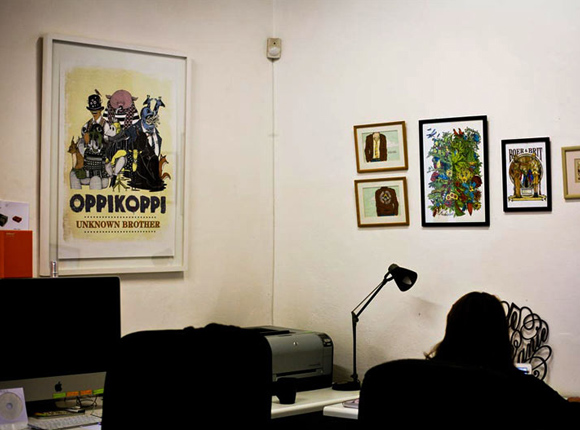
We don’t only design wine labels. We have also been involved with the artwork for the band Zinkplaat and events including Oppikoppie, Ramfest and Kamers Vol Geskenke.

labelsoffice

What is the best part about the work you do?

Working on creative projects, with creative people who are on the same wave length. The work hasn’t stopped since we started and we have had some very exciting opportunities. There is much more to come, watch this space.

Fanakalo Visual Communication Studio

021 883 3382
info@fanakalo.co.za
www.fanakalo.co.za